SealTex ST-2058 passes RoHS and TSCA testing
SealTex ST-2058 asbestos-free sheet has passed RoHS and TSCA tests conducted by SGS, a professional testing organization, and a detailed test report has been issued.
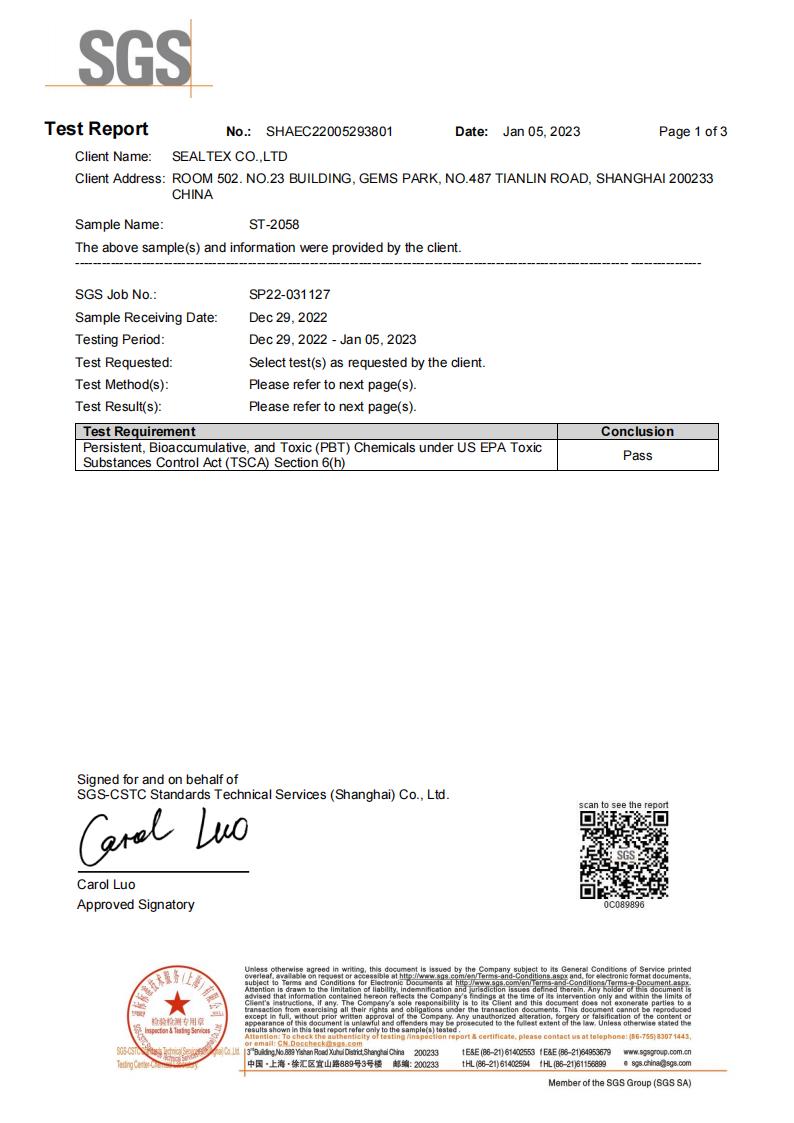
If you need the testing reports as above, please contact our corresponding business person
The U.S. Toxic Substances Control Act (TSCA), or TSCA for short.
The U.S. Toxic Substances Control Act (TSCA), [1] was enacted by the U.S. Congress in 1976 and became effective in 1977, with the U.S. Environmental Protection Agency (EPA) in charge of implementation. The Act aims to prevent "unreasonable risks" to human health and the environment by taking into account the environmental, economic, and social impacts of chemicals circulating in the United States. After several revisions, TSCA has become an important regulation for the effective management of chemical substances in the United States. TSCA compliance is a prerequisite for normal trade for companies whose products to the U.S. fall into the TSCA regulatory category.
Under TSCA regulations, non-compliant chemical substances, mixtures, or articles containing intentionally released substances are not allowed to enter the United States. U.S. Customs and Border Protection (CBP) requires products that fall under TSCA regulation or exemptions to provide a TSCA declaration at the time of entry. Companies must attach the printed statement to the paperwork for the imported product, and Customs, after consulting with EPA, will determine that the product is TSCA-compliant or exempt before approving it for entry.
As required by Section 6(h) of the Toxic Substances Control Act (TSCA), the EPA issued five final rules on January 6, 2021, to reduce exposure to certain persistent, bioaccumulative, and toxic chemicals (PBTs). The five final rules impose restrictions on decabromodiphenyl ether (decaBDE), isopropylated triphenyl phosphate (PIP (3:1)), 2,4,6-tri-tert-butylphenol (2,4,6-TTBP), pentachlorobenzenethiol (PCTP), and hexachlorobutadiene (HCBD), respectively. These chemicals accumulate in the environment over time and therefore may pose a potential risk to exposed populations. The above rules take effect on February 5, 2021, and will be phased in from March 8.
The TSCA list is a dynamic list of more than 86,000 chemical substances, divided into a public section and a confidential section. Substances included in the TSCA list are existing substances, while those not included are new substances. U.S. manufacturers and importers of existing and new substances are required to comply with the corresponding regulatory obligations.
